







Greeks Join Public Sector Strike Over Wages
X/ @gr_epress
May 13, 2026 Hour: 9:09 am
🔗 Comparte este artículo
Demonstrators accuse PM Mitsotakis of prioritizing military spending.
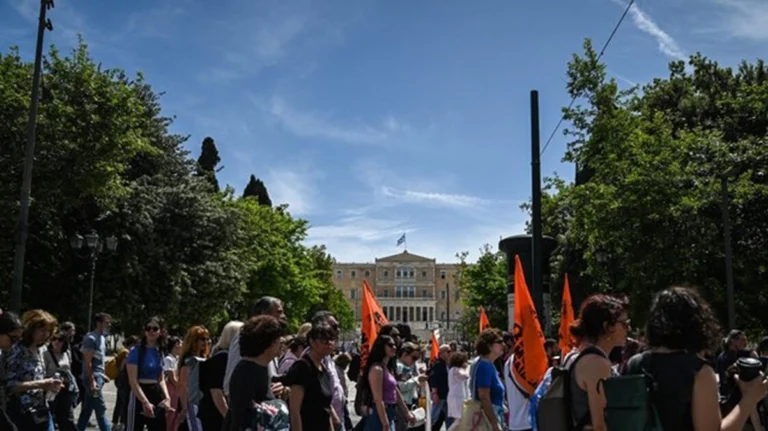
On Wednesday, thousands of Greeks joined a public sector strike to demand wage increases and measures against the rising cost of living from far-right Prime Minister Kyriakos Mitsotakis.
RELATED:
Greece Rules Out Intervention in The Strait of Hormuz
The Confederation of Greek Civil Servants’ Trade Unions (ADEDY) confirmed that the 24-hour strike was accompanied by massive demonstrations in cities such as Athens, Thessaloniki and Patras.
The demonstrators, mostly civil servants and pensioners, marched through the center of the capital to the Parliament carrying banners reading slogans such as “Give money to education and not to war” and “We demand decent wages.”
Although government offices and public services remained closed Wednesday, the strike did not affect public transportation.
“Our salaries have remained stagnant for years while everything is becoming more expensive: rents, basic goods. We can no longer make it to the end of the month,” civil servant Dora Theodoropulu said.
“This policy that degrades our lives and wastes enormous sums of money on military equipment while freezing spending on education, health care and social security can no longer continue,” retired teacher Grigoris Kalomiris said.
ADEDY is also demanding the restoration of two annual bonus payments for civil servants and pensioners, which were eliminated during the 2010-2018 sovereign debt crisis and have since only been restored for private-sector workers.
“The government has made the political decision not to reduce indirect taxes — which burden all citizens equally regardless of their income — and not to take measures against speculation,” ADEDY spokesperson Yorgos Petropulos said, noting that, since the debt crisis, standard VAT rate has been 24%, a percentage applied to most goods and services.
“Despite the exorbitant surpluses recorded, which are obtained mainly from high taxes on wage earners, the government refuses to reintroduce the two extra salaries,” he added.
Greece closed 2025 with a budget surplus of 4.29 billion euros (US$4.84 billion), equivalent to 1.7% of GDP, the largest recorded in the country in decades. However, Prime Minister Mitsotakis has refused to reduce the excise tax on gasoline, which — together with VAT — accounts for 65% of the final price.
In 2025, Greece and Bulgaria shared the last place in the European Union in terms of citizens’ purchasing power, which in both countries stood about 32% below the EU average, according to data from Eurostat.
teleSUR/ JF
Source: EFE